
The Question: How will I structure / manage my online engagement?
So that my efforts / actions:
- Are sustainable within my time constraints
- Achievable within my skillsets (those I have and/or willing to invest in developing)
- Also develop me in the ways I desire to continue to evolve and/or expand
The Temptation: Follow standard marketing practices.
Replicate / mimic templates, gurus, and/or trends.
The Consequence(s): of failing to acknowledge the purpose / intention of my communication – and how standard marketing was misaligned:
Marketing personas (avatars) are created for in/exclusionary (funneling) purposes. That’s neither my tactic, nor my strategy.
Becoming another “talking head” – aimless, self-serving
Poorly stewarding time – serving neither myself, nor others → only creating distraction.
The Exploration: How to establish a storytelling framework aligned to my discipline, outcomes, and impact?
As I made early attempts at creating content (website, social media,…etc.), I struggled to manage ‘perspectives’ within the storyline – on ‘flat’ black / white delivery.
My first iteration at resolving this was inspired by “entrepreneurs wear four hats” – which helped me to understand why I had struggled to succinctly convey varying perspectives. So, I created four characters:
- Owner / manager
- Technical Operations Researcher
- Marketing / Storyteller
- Board of directors
This showed promise – effort began to ease,…
The Insight: People remember relationships better than frameworks.
I began to recall how each of my courses throughout my graduate program (SUNY Stony Brook) had incorporated ‘project-based’ application into what I call a ‘sandbox for competency’ strategy.
I began to recognize how my mind doesn’t (first) recall the method – rather the project the method was learned through the fictional scenario that I was to create an analytical model for and then write up (founded /informed) recommendations.
The Porteolas connection: How does this influence how I work today?
Narratives aid in revealing systems’ (il)legibility.
Each of my (Stony Brook) projects were developing a particular methodology.
My professional use of that training has integrated cross-functional teams to establish a “one source of truth” operations – facilitating shared understanding.
Together, they’ve inspired my intention for communication and how I came to approach delivery:
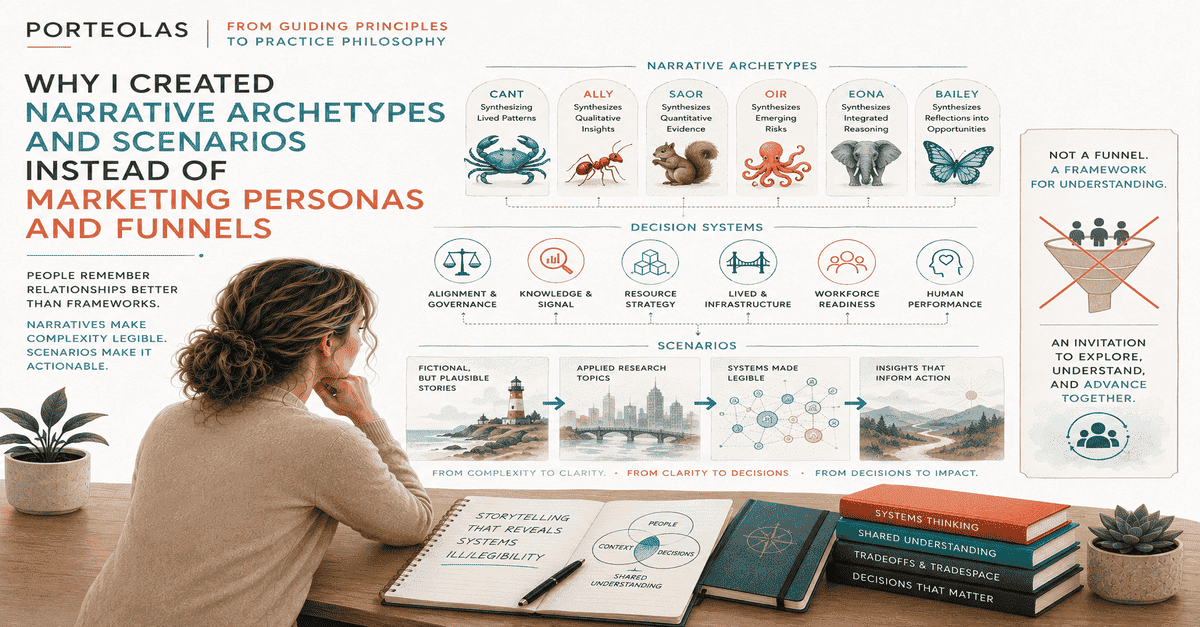
- Decision systems
- Alignment & Governance (stewardship, compromises, …)
- Knowledge & Signal (filter, validate, interpret, …)
- Resource Strategy (acquire, allocate, prioritize, …)
- Infrastructure & Lived (physical, environmental, social,…)
- Workforce Readiness (knowledge, skills, abilities,…)
- Human Performance (physical, cognitive,…)
- Narrative archetypes
- Cant – synthesizes systemic patterns & tensions
- Ally – synthesizes qualitative insights
- Sleat – synthesizes quantitative evidence
- Oir – synthesizes emerging risks
- Bailey – synthesizes reflections into adaptability
- Eona – synthesizes integrated reasoning, coordinating the path forward
- Decision systems
These systems and archetypes will playout through applied research topics / scenarios – which will become useful artifacts to inspire / facilitate decision making.
Operations Research (OR) exists to inform – not replace – decision-making.
It doesn’t:
- govern organizations
- execute strategy
- make decisions on behalf of others
Instead, OR creates ways to reason through complexity before commitments are made.


