
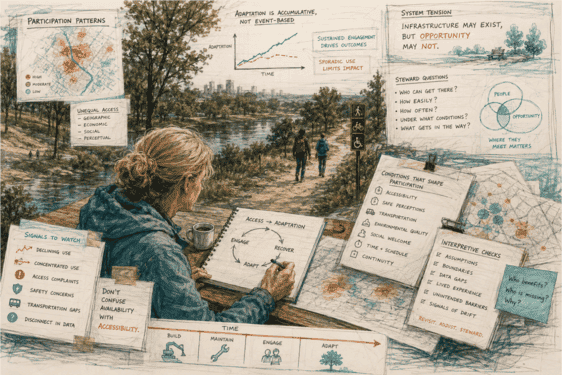
SCENARIO (What’s happening):
A fictional-but-plausible regional coalition of community organizations, parks departments, public health stakeholders, veteran-serving nonprofits, and community planners begins examining whether existing outdoor recreation and green-space infrastructure is adequately supporting opportunities for long-term health, recovery, and wellness across the community.
On paper, the region appears well-positioned.
✔️ Parks exist.
✔️ Trails exist.
✔️ Recreational assets are maintained.
✔️ Outdoor programming is available.
✔️ The infrastructure is functioning largely as designed.
Yet within the fictional scenario, participation patterns suggest a more uneven lived reality.
Some communities consistently engage with outdoor spaces. Others make less use of nearby assets despite their geographic proximity.
Populations that might benefit from recovery-supporting environments may encounter conditions traditional infrastructure measures don’t fully capture:
- accessibility,
- transportation,
- safety perceptions,
- environmental continuity,
- usability,
- scheduling realities,
- and social comfort.
The distinction matters because infrastructure can function exactly as designed while the conditions it was intended to support remain unevenly experienced.
A Daniels-Banister-inspired fatigue / recovery simulation provides one analytical surface for exploring why that distinction might matter.
The simulation does not model parks, accessibility, participation, or community wellness outcomes. Nor does it predict what a particular community will experience – instead, it makes adaptation and recovery dynamics over time available for exploration.
The surrounding fictional scenario asks a broader systems question:
If adaptation and recovery depend upon sustained participation over time, how should communities examine the accessibility of environments that make those opportunities possible?
The analytical connection
❌ isn’t: infrastructure → wellness outcomes.
✔️ it’s an inquiry into the conditions connecting:
Physical infrastructure → participation opportunity → sustained engagement → conditions supporting adaptation
Those relationships remain open to context, lived experience, interpretation, and human judgment.
Within that applied scenario,

(Interested Stakeholders)
have reason to care when the presence of functioning community assets doesn’t necessarily translate into meaningful opportunities for sustained participation. Their stake may differ – responsibility for community infrastructure or programming, dependence upon accessible environments, participation in the opportunities those environments support, or exposure to the consequences – but the underlying concern is shared:
What conditions may be limiting meaningful access even when the infrastructure itself remains available and functioning as designed?
The central Infrastructure & Lived tension becomes:
When does a community asset become meaningfully accessible rather than merely available?
Throughout the scenario, Porteolas’s narrative archetypes serve as perspective scaffolds for interrogating the challenge. They do not represent actual stakeholders or participants. Each introduces a different reasoning perspective through which assumptions, signals, tensions, and adaptations can be examined
Together, W.E. S.E.A (How this is being approached):
W: What’s Next Previews

metaphor (patterns & tensions)
highlights the growing distance that can emerge between what infrastructure makes available and what people can realistically experience.
Cant doesn’t necessarily appear through deterioration.
✔️ The park can remain open.
✔️ The trail can remain maintained.
✔️ The program can remain available.
✔️ The asset can continue functioning according to design.
Yet accessibility assumptions may gradually become less aligned with lived conditions.
That is the reason to look.
The emerging question is, therefore, not simply whether sufficient infrastructure exists; it’s:
Who has realistic opportunities to engage with that infrastructure, under what conditions, and with what continuity over time?
Attention begins shifting from infrastructure availability toward infrastructure accessibility.
This doesn’t make availability unimportant.
It asks whether availability alone provides enough information to understand how physical systems function within lived environments.
E: Enhancements

Quantitative Methods
perspective, the Daniels-Banister-inspired fatigue / recovery simulation provides a formative analytical surface for examining adaptation, recovery, and readiness dynamics over time.
The objective isn’t to
- model parks,
- predict community health outcome,
- determine whether particularly infrastructure investments will produce adaptation.
Instead, the simulation makes several modeled dynamics available for exploration:
- adaptation accumulates over time,
- recovery matters,
- readiness changes,
- and repeated engagement matters differently from isolate activity.
That creates a useful question for the surrounding Infrastructure & Lived scenario.
If adaptation depends upon repeated engagement, what conditions make opportunities for that engagement realistically available over time?
Traditional infrastructure discussions may ask how many:
- parks exist?
- miles of trails are available?
- facilities were constructed?
The scenario adds another set of questions:
- who can realistically access them?
- under what conditions?
- with what consistency?
- what might interrupt participation?
- which barriers remain invisible within conventional infrastructure measures?
The contribution isn’t the simulation alone; it’s using the modeled fatigue / recovery dynamics to make a broader question available for reasoning:
What environmental and lived conditions support – or interrupt – the sustained participation through which adaptation can accumulate over time?

Disruption Steward
perspective, the inquiry remains centered on whether the conditions supporting adaption opportunities remain sufficiently visible as infrastructure and community conditions evolve.
S: Stewardship

Risk Sentinel
perspective, stewardship extends beyond whether physical infrastructure remains operational.
✔️ The parks, trails, and recreational assets may continue functioning as intended.
✔️ Maintenance schedules may be met.
✔️ Facilities may remain operational.
✔️ Traditional infrastructure measures may continue signaling success.
But infrastructure remaining available doesn’t necessarily tell us whether the conditions supporting repeated participation remain equally usable over time.
The question becomes:
How do we distinguish infrastructure that exists and functions from infrastructure that remains meaningfully relevant within lived conditions?
Cant remains present here – not as infrastructure failure, but through a growing distance between environments that remain available and the lived conditions that shape whether people can continue engaging with them.
One transportation constraint.
One scheduling barrier.
One safety concern.
One interruption in continuity.
Individually, each may appear manageable. Together, they can influence whether participation remains consistent enough for adaptation and recovery to accumulate over time.
The vulnerability emerges when availability becomes a sufficient proxy for accessibility without examining the conditions between them.
Questions follow:
- Which barriers remain invisible within traditional planning assumptions?
- How is accessibility being interpreted?
- Who or what defines successful utilization?
- Which assumptions connect infrastructure presence with participation opportunity?
- When were those assumptions last revisited?
Infrastructure stewardship, therefore, extends beyond preserving assets.
It includes periodically revisiting the assumptions connecting those assets to the conditions they were intended to support.
E: Engagement

Qualitative Methods
perspective, this fictional scenario considers how different groups might experience the same infrastructure environment differently.
A park support function might see maintained facilities.
A public-health perspective might focus on patterns of physical activity and wellness opportunity.
A veteran-serving organization might encounter transportation or participation barriers.
Community members might experience safety, scheduling, accessibility, or social-comfort conditions differently.
Neighborhood perspectives might reveal differences that geographic service-area measures alone do not make visible.
These are fictional-but-plausible scenario perspectives, not findings from stakeholder interviews or a regional study.
Their analytical purpose is to examine how multiple interpretations of the same physical environment can coexist.
The perspectives may reveal different portions of the same system.
Infrastructure can be measured through:
- maintenance,
- utilization,
- availability,
- coverage,
while being experienced through:
- access,
- usability,
- continuity,
- environmental conditions,
- convenience,
- and participation opportunity.
Through Ally’s perspective, the question becomes:
What does lived experience make visible that infrastructure measures alone may not?

Adaptability & Improvement
perspective, another question follows:
How might accessibility assumptions need to evolve as community conditions change?
A: Agility Tips
Infrastructure rarely loses relevance all at once.
Watch for situations where:
- opportunities for participation exist, but continuity / consistency is difficult to sustain,
- recovery-supporting environments are available, but lived conditions interrupt consistency,
- access appears sufficient geographically, while timing, transportation, safety or usability constrain actual use,
- or participation conditions change faster than assumptions about accessibility are revisited.
Don’t automatically assume:
🟠 Availability equals access
🟠 Proximity equals usability
🟠 Utilization equals impact
Or
🟠 Construction equals resilience
Ask instead:
- What barriers exist between infrastructure and participation opportunity?
- Which populations encounter those barriers differently?
- What assumptions currently define infrastructure success?
- What conditions influence sustained engagement over time?
- Which assumptions remain valid – and which deserve another look?
Agility means keeping accessibility assumptions revisitable as physical and lived conditions evolve.
Evidence Surfaces (What emerged through engagement with the challenge):
Rationale & Tradeoffs
The central tension can be expressed as: availability versus accessibility.
This isn’t an either / or choice.
Infrastructure planning reasonably attends to:
- asset delivery,
- geographic coverage,
- maintenance,
- availability,
- and utilization.
Communities encounter those assets through additional conditions:
- access, usability,
- continuity,
- safety,
- convenience,
- and participation opportunity.
The challenge is understanding where infrastructure presence and lived accessibility begin drifting apart.
Availability is generally easier to observe and measure.
Accessibility may depend upon interacting physical, environmental, social, temporal, and experiential conditions.
The fatigue / recovery simulation helps explain why the distinction is worth examining.
It doesn’t demonstrate that accessible infrastructure creates wellness outcomes; it demonstrates modeled adaptation dynamics over time, providing an analytical basis for asking:
What sustained engagement might require from the environments that make participation possible?
Exploratory Scenarios
Several futures remain operationally plausible.
These aren’t forecasts or predicted outcomes. They provide alternative reasoning environments for examining how infrastructure availability, accessibility, participation conditions, and changing assumptions might interact.
Scenario A – Accessible Wellness Ecosystem
Explore a future in which infrastructure planning increasingly incorporates lived accessibility considerations.
Under what conditions might participation opportunities become more broadly available?
What would need to remain visible to understand whether infrastructure and lived conditions were becoming more aligned?
Scenario B – Infrastructure Without Engagement
Explore a future in which physical assets continue to be developed and maintained while participation remains concentrated among existing users.
What might explain persistent differences between infrastructure availability and participation opportunity?
When might continued asset success obscure unresolved accessibility conditions?
Scenario C – Reactive Wellness Cycle
Explore a future in which access barriers remain insufficiently understood while opportunities for sustained participation remain uneven.
What assumptions might lead communities to focus increasingly on downstream wellness responses without fully examining upstream participation conditions?
The scenario doesn’t establish that infrastructure accessibility would prevent those downstream needs. It asks whether accessibility assumptions deserve greater scrutiny within the broader system.
Scenario D – Adaptive Community Stewardship
Explore a future in which planners, infrastructure stewards, community organizations, and other participants increasingly examine recovery-supporting environments through both physical -system and lived-system perspectives.
What would allow infrastructure assumptions to evolve alongside changing community conditions?
These pathways aren’t intended to determine which infrastructure strategy is correct.
They expose different assumptions, dependencies, participation conditions, and interpretive tensions for examination before subsequent commitments narrow the available tradespace.
Retrospectives
A hypothetical retrospective allows the fictional scenario to examine what earlier infrastructure assumptions might look like after contact with evolving lived conditions.
Suppose the scenario is carried forward several years.
What would stakeholders need to examine before concluding that the infrastructure was producing the opportunities originally expected of it?
Does infrastructure availability adequately represent the opportunity people actually have to engage with it?
Thinking Aloud
This scenario leaves several perspectives’ questions intentionally unresolved:
Ally asks:
Sleat asks:
Oir asks:
Bailey asks:
Eona asks:
“Which lived conditions change how people experience the same physical environment?”
“What do modeled adaptation dynamics help us understand about sustained engagement – and what remains outside the simulation?”
“Which assumptions about accessibility or infrastructure success remain largely untested?”
“How might those assumptions need to adapt as community conditions evolve?”
“How do we keep physical-system evidence, lived experience, adaptation dynamics, and changing conditions available for reasoning without prematurely collapsing them into a single definition of infrastructure success?”
These perspectives don’t determine whether particular infrastructure is accessible – together, they make more of the conditions shaping that interpretation available for examination.
Toolchain / Stackmap
The analytical work demonstrated in this scenario brings together:
- fatigue / recovery simulation,
- adaptation and recovery interpretation,
- infrastructure-stewardship reasoning,
- qualitative perspective-taking,
- assumption exploration,
- and operational retrospection.
Other contextual domains such as:
- Community Planning,
- Parks & Recreation Systems,
- Public Health Analytics,
- Accessibility Assessment,
- Human Performance Modeling,
- GIS & Spatial Analysis,
are relevant to explaining a real-world problem of this kind.
The simulation contributes the human health recovery / resilience perspective to infrastructure planning.
Emerging Patterns & Watchlists
Community / Utilization Signals
- uneven / changing participation / engagement patterns,
- widening wellness disparities,
- differences in continuity of use.
Infrastructure Signals
- asset availability without corresponding participation opportunity,
- utilization clustering,
- recurring accessibility concerns,
- transportation barriers,
- increasing disconnect between planning assumptions and lived experience.
Interpretive / Stewardship Signals
- infrastructure success measured primarily through asset metrics,
- declining visibility into participation conditions,
- assumptions becoming increasingly implicit,
- accessibility interpreted too narrowly,
- resilience outcomes becoming increasingly difficult to attribute.
Cant‘s watchlist remains simple:
Infrastructure rarely loses relevance through physical failure alone.
More often, relevance erodes when assumptions about accessibility remain unchanged while community conditions continue evolving.
The question isn’t whether infrastructure exists; it’s whether opportunities for sustained engagement remain realistically accessible within the communities those systems were intended to serve.
Operational Reflection (What’s shaping your choices):
Has Cant quietly entered the conversation?
Not through deterioration.
Not through failure.
But through growing distance between what exists and what is actually experienced.
When participation remains uneven despite expanded access, what assumptions are shaping how success is being interpreted?
Where might effort continue moving while outcomes remain largely unchanged?
Is progress occurring – or is the system gradually moving sideways around barriers that remain unresolved?
What conditions are being measured because they are visible, while other conditions remain influential precisely because they are harder to see?
When infrastructure appears successful on paper:
how often are the underlying assumptions revisited before Cant‘s subtle forms of drift – scope, accountability, expectations, or interpretation – become embedded in the system itself?
These questions remain deliberately unresolved.
The purpose of the decision environment isn’t to determine what infrastructure a community should build, where it should build it, or what accessibility intervention it should pursue.
It’s to make more of the assumptions, lived conditions, participation opportunities, dependencies, and interpretive differences available for examination before commitments narrow the available options.


