
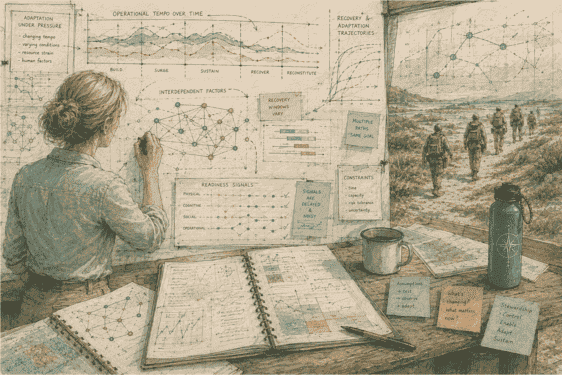
SCENARIO (What’s happening):
High-tempo environments rarely struggle from a lack of effort.
More often, operational performance continues while the conditions supporting sustainable readiness begin to change.
A fictional-but-plausible readiness-focused organization begins exploring whether fatigue/recovery modeling can help make adaptation pressures, recovery variability, and sustainment tradeoffs more visible across changing operational conditions.
At first, the question appears relatively straightforward:
“What can observable human performance signals tell us about readiness over time?”
But a deeper tension quickly emerges.
Continued performance doesn’t necessarily establish that the conditions supporting that performance remain equally sustainable.
As operational demands evolve, recovery assumptions may be challenged. Adaptation and fatigue may unfold differently over time. Yet visible performance can continue providing reassurance.
That’s where Cant creates the reason to look.

metaphor (patterns & tensions)
doesn’t necessarily appear through catastrophic failure; here, Cant appears through the gradual normalization of changing adaptation and recovery conditions while operational performance continues.
The challenge therefore becomes more than measuring fatigue; it becomes:
“How do we distinguish visible performance from sustainable readiness as the conditions shaping adaptation and recovery evolve?”
The tension: operational success can continue masking accumulating adaptation pressure – making interpretive discipline increasingly important before normalized strain becomes operationally invisible.
Within that applied scenario,

(Interested Stakeholders)
have reason to care when continued performance can no longer, by itself, establish whether the conditions supporting that performance remain sustainable. Their stake may differ – accountability for readiness, dependence upon sustained human performance, responsibility for the conditions under which performance occurs, or exposure to the consequences – but the underlying concern is shared:
What adaptation or recovery pressures may be becoming consequential even while observable performance continues to suggest that everything is working?
Throughout the scenario, Porteolas’s narrative archetypes serve as perspective scaffolds for interrogating the challenge. They do not represent actual stakeholders or participants. Each introduces a different reasoning perspective through which assumptions, signals, tensions, and adaptations can be examined
Together, W.E. S.E.A (How this is being approached):
W: What’s Next Previews
Readiness discussions can stabilize around what is easiest to observe and measure.
Yet readiness itself unfolds over time.
Training loads change and – fatigue accumulates and decays.
Recovery matters.
Adaptation develops under assumptions that may or may not continue fitting evolving operational conditions.
The organization therefore begins exploring a Daniels-Banister-inspired fatigue / recovery simulation – not as an answer to readiness, but as an analytical environment for examining how modeled adaption, fatigue, and recovery trajectories respond under changing assumptions.
Cant remains present in the background.
Operational performancy may continue…
Current expectations may still appear supportable…
Nothing needs to ‘fail’ for the underlying question to become consequential:
“Do the conditions supporting our current interpretation of readiness still hold?”
This shifts attention away from simply increasing observability toward examining what readiness signals actually mean as conditions evolve.
E: Enhancements

Quantitative Methods
perspective, the Daniels-Banister-inspired simulation provides a bounded analytical surface for exploring fatigue, recovery, and adaptation over time.
The model allows selected assumptions to be varied, including:
- training-load pattern / intensity,
- fitness / adaptation gain,
- fatigue gain,
- fitness / adaptation decay,
- fatigue / recovery decay,
- initial VO2Max,
- and the period being simulated.
Those assumptions influence the modeled fitness, fatigue, and V02Max trajectories that become available for examination.
The objective is not prediction; it’s to make relationships and sensitivities visible enough to reason with.
The simulation does not model sleep disruption, environmental stressors, team behavior, organizational culture, mission outcomes, or operational decision quality – nor does it determine whether a person or organization is “ready”. Those require context beyond the model.
Instead, the environment allows questions such as:
- What changes when training load changes?
- How do modeled fatigue and adaptation respond over time?
- How sensitive are resulting trajectories to recovery assumptions?
- Which assumptions materially alter what becomes visible?
- Under what modeled conditions do adaptation and fatigue appear differently balanced?
This is where the model becomes useful – as an interpretive environment rather than predictive authority
Through Sleat’s perspective, more signals don’t automatically produce more understanding – they create additional evidence to interpret.

Risk Sentinel
perspective, that distinction invites another set of questions:
- Which assumptions are shaping the trajectories?
- Under what conditions do those assumptions remain defensible?
- What lies outside the models’s validity?
- Where might confidence in an output exceed what the analytical environment actually supports?
The model, therefore, remains deliberately bounded.
Human judgment remains responsible for deciding what those (visible) dynamics mean within an actual operational environment.
S: Stewardship

Disruption Steward
perspective, attention shifts from whether the model can produce a readiness signal toward whether that signal remains defensibly interpreted.
That distinction matters because increased visibility can create increased confidence – but, confidence is not the same as validity.
A modeled trajectory is conditional upon the assumptions that produced it.
If operational conditions change while those assumptions remain static, the resulting interpretation deserves renewed examination.
The stewardship question becomes:
“Does our interpretation of adaptation and recovery remain defensible under the conditions we are now operating within?”
This doesn’t require abandoning useful models or measures whenever circumstances change; it requires keeping visible:
- the assumptions supporting interpretation,
- the conditions under which confidence was established,
- the limits of what that model represents,
- and the contextual information necessary to interpret its outputs.
Cant reappears here through normalization and interpretive drift.
One period of increased demand may be temporary.
One compressed recovery period may be manageable.
One altered assumption may remain reasonable.
The concern isn’t any single occurrence; it’s whether changing conditions gradually become accepted as normal without revisiting what those changes mean for the interpretation of sustainable readiness.
Stewardship, therefore, becomes less about seeking certainty and more about maintaining interpretive integrity as assumptions, tempo, and operational realities continue shifting.
E: Engagement

Qualitative Methods
perspective, the fictional scenario considers what the quantitative trajectories cannot explain on their own.
A modeled fatigue / recovery trajectory can show what occurs within the assumptions of the simulation – it cannot independently explain the operational conditions surrounding those dynamics.
Within a real environment, people occupying different roles may bring different contextual knowledge to the same readiness signal.
One perspective may emphasize observable performance.
Another may question recovery opportunity.
Another may understand how operating conditions have changed since assumptions were established.
Another may challenge whether the signal being examined still represents the phenomenon decision makers believe it represents.
These are plausible perspectives used for reasoning – not findings, from interviews or stakeholder research.
Their purpose is to preserve contextual questions that quantitative visibility alone cannot resolve.
The tension: different stakeholders can inherit different meanings from the same readiness indicators, making operational interpretation – not merely agreements on metrices, the consequential issue.
Through Ally’s perspective, the question becomes:
“What context would we need before assigning operational meaning to what the model makes visible?”

Adaptability & Improvement
perspective, another question follows:
“Which interpretations need to remain revisitable as human and operational conditions evolve?”
The model remains available for exploration.
The interpretation remains open to challenge.
A: Agility Tips
Human readiness is dynamic rather than static.
The simulation makes that concept explorable by allowing load, adaptation, fatigue, and recovery assumptions to change over time.
But agility doesn’t mean reacting to every change in a modeled trajectory.
Instead, what for situations in which:
- continued performance is treated as sufficient evidence of sustainable readiness,
- recovery assumptions remain static while surrounding conditions change,
- variability becomes increasingly normalized,
- confidence in readiness signals grows without corresponding examination of their assumptions,
- or operational demands evolve faster than the interpretation supporting current readiness expectations.
These are conditions deserving examination, not evidence that degradation has occurred; ask:
- What assumptions support the current readiness interpretations?
- Which conditions would challenge those assumptions?
- What does the model actually make visible?
- What remains outside it?
- What additional context would be necessary before assigning operational meaning?
- When should an earlier interpretation be revisited?
Agility therefore depends not upon eliminating strain – but upon preserving enough interpretive awareness to recognize when changing conditions warrant another look.
Evidence Surfaces (What emerged through engagement with the challenge):
Rationale & Tradeoffs
More data doesn’t necessarily resolve readiness uncertainty.
The more consequential question is whether confidence remains justified as conditions move beyond the assumptions that originally supported interpretation.
That creates several useful tensions:
Increased observability ↔ increased interpretive burden
More signals create more evidence – also more relationships and assumptions to interpret:
Standardization ↔ contextual nuance
Consistent measures support comparison, while operational meaning may remain conditional upon context:
Signal visibility ↔ interpretive confidence
A visible trajectory can improve legibility without establishing certainty:
Model simplicity ↔ operational complexity
A bounded model can make selected dynamics easier to reason about precisely because it doesn’t attempt to represent every surrounding condition:
Continued performance ↔ sustainable readiness
Observable performance can remain consequential evidence without necessarily answering whether adaptation and recovery conditions remain sustainable.
The purpose is, therefore, not to transform fatigue / recovery modeling into a precision readiness-prediction system.; it’s to keep the relationships among modeled dynamics, assumptions, operational context, and human judgment sufficiently legible to permit challenge.
Exploratory Scenarios
Several plausible reasoning environments can be explored.
These are not forecasts, empirical findings, or outcomes generated by the simulation; they’re hypothetical conditions for asking how interpretation might need to change as the relationship among performance, adaptation, recovery, and operational context evolves.
Scenario A – Continued Performance, Changing Margin
Suppose observable performance remains strong while modeled fatigue / recovery dynamics begin responding differently under changed assumptions.
What additional context would be needed before interpreting continued performance as evidence of sustainable readiness?
At what point would changing recovery assumptions deserve greater attention?
What would justify confidence that the existing interpretation still fits?
Scenario B – Recovery Assumptions Normalize
Suppose periods of compressed recovery become increasingly familiar within a high-tempo environment.
The simulation does not determine whether those periods are acceptable or harmful; instead, ask:
“Have the assumptions supporting our interpretation changed along with the operating conditions – or have yesterday’s assumptions quietly become attached to today’s environment?”
Scenario C – Similar Output, Different Dynamics
Suppose two modeled configurations produce superficially reassuring output while the underlying balance among load, fatigue, recovery, and adaptation differs.
What would the headline signal conceal?
Which underlying assumptions would need to remain visible?
How much confidence should be attached to the apparent similarity?
Scenario D – Interpretation Remains Adaptive
Suppose changing model trajectories prompt renewed examination rather than an immediate operational conclusion.
Which assumptions would deserve challenge?
What contextual information would be needed?
What remains unknowable from the model?
And:
“Who retains authority for determining what those dynamics mean within the actual operational environment?”
The purpose of each scenario is to make the decision space more examinable – not to prescribe the path through it.
Retrospectives
A hypothetical retrospective offers another way to examine interpretive drift.
Suppose the organization looks back after a period of sustained operational demand.
Performance may have remained visible.
The model may have continued producing usable trajectories.
Existing readiness indicators may have continued appearing familiar.
The retrospective doesn’t ask whether the model “predicted” what happened; instead, it asks:
- Which assumptions remained stable?
- Which operating conditions change?
- Which variations became normalized?
- When did earlier interpretations stop receiving meaningful challenge?
- What contextual information become important – only after conditions evolved?
Cant appears retrospectively not as a singular disruption, but through accumulated normalization.
Perhaps:
- an assumption remained in place because nothing visibly failed,
- changing recovery conditions gradually became ordinary,
- or continued execution reinforced confidence in an interpretation that deserved another look.
None of those possibilities establishes that readiness degraded; they surface a more disciplined question:
“At what point should confidence in an existing readiness interpretation have been reconsidered?”
Thinking Aloud
This scenario leaves several questions intentionally unresolved:
Ally asks:
Sleat asks:
Oir asks:
Bailey asks:
Eona asks:
“What operational context is necessary before assigning meaning to those trajectories?”
“What do the modeled trajectories actually show – and which conclusions remain outside the model?”
“Which assumptions and validity conditions support confidence in the current interpretation?”
“Which interpretations need to remain adaptable as conditions evolve?”
“How do we preserve defensible readiness interpretation without converting conditional analytical evidence into certainty?”
No archetype determines whether readiness is adequate – together, they make different dimensions of the decision environment available for reasoning.
Toolchain / Stackmap
The analytical work demonstrated through this scenario includes:
- Daniels-Banister-inspired fatigue / recovery simulation,
- parameter exploration,
- modeled trajectory visualization,
- scenario reasoning,
- assumption examination,
- contextual interpretation,
- and operational retrospection.
The simulation provides a bounded quantitative surface for examining adaptation, fatigue, recovery, and VO2Max trajectories under changing modeled assumptions.
The surrounding Human Performance storyline provides the context through which questions of sustainable readiness, interpretation, validity, and changing operational conditions can be considered.
Other methods and domains – such as qualitative human performance inquiry, operational observation, governance review, physiological assessment, or additional readiness measures – could contribute relevant evidence within a real engagement.
They are neither represented here as capabilities built into nor analyses performed by this simulation.
The value, therefore, doesn’t emerge from the model alone; it emerges from keeping modeled dynamics, assumptions, operational context, and human judgement legible together.
Emerging Patterns & Watchlists
Within this fictional Human Performance scenario, conditions deserving continued observation might include:
Modeled Dynamics
- changing fatigue trajectories,
- changing recovery trajectories,
- sensitivity to training-load assumptions,
- sensitivity to adaptation and decay assumptions,
- divergence among modeled trajectories as parameters change.
Operational / Contextual Conditions
- sustained or changing operational tempo,
- changing assumptions about available recovery,
- continued performance under evolving conditions,
- increasing normalization of variability,
- differences between what is modeled and what is occurring in the lived operational environment.
Interpretive / Stewardship Conditions
- increasing confidence detached from explicit assumptions,
- reduced questioning because performance continues,
- modeled outputs treated as operational conclusions,
- boundary conditions becoming less visible,
- earlier readiness interpretations remaining stable while surrounding conditions change.
Not all of these are model outputs.
Some are contextual conditions surrounding the fictional scenario. Others become relevant because the simulation makes selected adaptation and recovery dynamics easier to examine.
Cant’s watchlist – therefore, remains less concerned with dramatic failure than with normalization:
When does continued performance make changing conditions easier to accept without challenge?
When do recovery assumptions become inherited rather than examined?
When does variability stop prompting questions?
And when does confidence in readiness begin exceeding the conditions that originally justified it?
These questions warn that stable indicators can coexist with shrinking margins and increasing confidence detached from lived conditions.
Operational Reflection (What’s shaping your choices):
At what point does sustained operational performance stop reflecting sustainable readiness?
What assumptions within your environment remain trusted because disruption has not yet become visible?
Where might adaptation pressure already be becoming normalized within your operational tempo?
What do your current readiness signals actually make visible?
What remains contextual? Uncertain?
And:
“How does your organization recognize when confidence in readiness has outpaced the conditions that originally justified it?”
A model can make fatigue, recovery, adaptation, and their sensitivities more available for exploration – it cannot:
❌ determine whether operational performance remains sustainable
❌ decide what level of strain is acceptable
❌ establish the meaning of conditions it doesn’t represent
❌ and – it doesn’t own the readiness decision.
Those judgments remain with the people responsible for understanding the actual human and operational environment.
The purpose of this decision environment is therefore more provisional:
Make modeled adaptation and recovery dynamics, their underlying assumptions, and the limits of their interpretation visible enough to reason with before confidence hardens around an incomplete picture.
The edges of how become more visible.
The path through remains a human decision.


