
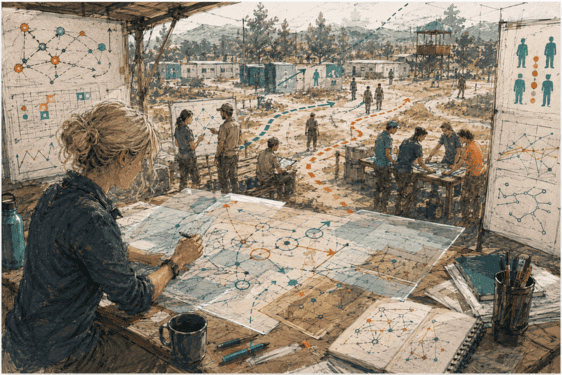
SCENARIO (What’s happening):
A fictional-but-plausible organization responsible for a highly spcialized workforce faces growing operational demand.
On paper, the workforce appears ready.
✔️ Required positions remain filled.
✔️ Certifications remain current.
✔️ Training completion rates remain healthy.
✔️ Operational demand continues to be met.
Yet within the fictional scenario, subtle operation friction begins to appear.
⚙️ The same personnel are repeatedly relied upon for demanding assignments.
⚙️ Recovery appears uneven.
⚙️ Schedule disruptions become harder to absorb.
⚙️ Newer personnel require time to develop proficiency.
⚙️ Readiness profiles vary across individuals.
No single indicator suggests immediate concern.
No formal readiness threshold has been crossed.
The organization remains staffed an operational.
Yet capability appears less resilient than familiar workforce indicators might suggest.
That is where

metaphor (patterns & tensions)
begins to surface as ‘creeping disruptions’ – giving us a reason to look: appearing through small differences accumulating beneath otherwise stable indicators
- recovery,
- workload distribution,
- adaptability,
- and operational flexibility begin changing while the workforce appears ready – on paper.

(Interested Stakeholders)
have reason to care when continued operational performance depends upon a workforce whose readiness conditions may be becoming less resilient beneath otherwise stable indicators. Their stake may differ – accountability for mission or operational continuity, dependence upon specialized capability, responsibility for workforce readiness, or exposure to the consequences – but the underlying concern is shared:
What happens when the capacity to continue meeting demand becomes increasingly dependent upon conditions the organization’s familiar workforce indicators don’t full reveal?
The question emerging beneath the surface is, therefore, not simply:
“Do we have enough people?”
It’s:
“How sustainably is capability being carried as readiness conditions evolve?”
Throughout the scenario, Porteolas’s narrative archetypes serve as perspective scaffolds for interrogating the challenge. They do not represent actual stakeholders or participants. Each introduces a different reasoning perspective through which assumptions, signals, tensions, and adaptations can be examined
Together, W.E. S.E.A (How this is being approached):
W: What’s Next Previews
Readiness challenges rarely announce themselves through a sing indicator.
Small shifts may appear first in adaptation, workload distribution, recovery, and operational flexibility – before anything rises to the level of a formal readiness concern.
A highly specialized workforce can therefore continue meeting its operational commitments while the conditions supporting that capability begin changing.
Cant highlights that emerging divergence.
The issue isn’t necessarily that workforce metrics are wrong.
✔️ Staffing counts can accurately describe staffing.
✔️ Certification records can accurately describe certification status.
✔️ Training records can accurately describe completion.
But those measures answer a different question from:
“How is human readiness adapting under sustained or changing demand?”
And, at the organizational level:
“What might variations in readiness conditions mean for how sustainably capability is carried out?”
That creates an opportunity to examine readiness variability before visible performance degradation forces the issue into view.
E: Enhancements

Quantitative Methods
perspective, a Daniels-Banister-inspired fatigue / recovery simulation provides a formative analytical surface for exploring physiological adaptation and recovery dynamics over time.
The objective isn’t prediction – it’s visibility.
The simulation does not model:
- staffing levels,
- certifications or qualifications,
- proficiency development,
- workforce distribution,
- organizational redundancy,
- or team-level mission capability.
Those belong to the fictional Workforce Readiness scenario surrounding the analytical model.
Instead, the simulation allows assumptions affecting fatigue, recovery, and adaptation to be varied so their changing trajectories can be examined over time.
That matters within this decision-system perspective because, readiness isn’t necessarily static.
Repeated demands can interact with adaptation and recovery differently depending upon the conditions being explored.
The model therefore creates an analytical surface for asking:
- how might changing demand affect fatigue / recovery trajectories
- how does adaptation develop over time under different modeled conditions
- what becomes visible when recovery and adaptation do not move uniformly
- which assumptions materially change the readiness trajectories being observed
The model doesn’t answer whether an organization has sufficient staffing or whether capability is appropriately distributed.
Instead, it gives the surrounding scenario something more grounded to reason from:
Physiological readiness can vary over time even while conventional workforce indicators remain unchanged.
That creates the broader systems question:
What might readiness variability mean for how sustainably operational capability is being carried across a specialized workforce?

Disruption Steward
perspective, the inquiry remains open: The purpose is not to predict who will succeed or fail – but, to keep changing readiness conditions visible before incomplete assumptions begin constraining interpretation.
S: Stewardship

Risk Sentinel
perspective, turns attention toward what the organization believes its readiness indicators represent.
Workforce measures remain useful – they may accurately describe:
- staffing,
- qualifications,
- certification / training completions,
- and other (readily) observable workforce conditions
But physiological readiness introduces another dimension.
A workforce can remain present and qualified while adaptation, fatigue, and recovery vary among the people carrying operational demands.
That makes interpretation consequential.
Measures intended to improve visibility can also influence what organizations pay attention to and how readiness is understood.
The stewardship question is therefore not whether conventional measures should be abandoned; it’s:
“How do we preserve confidence that the indicators being used still represent the dimensions of readiness we believe they represent?”
Cant remains present here through interpretive drift.
Not because a metric suddenly becomes false; rather, familiar indicators may continue signaling stability while conditions relevant to sustainable readiness become more variable.
One difficult recovery period.
One additional demanding assignment.
One scheduled disruption.
One growing dependency on personnel who ‘can’ absorb it.
None establishes a readiness problem by itself; together, however, such conditions may provide reason to question whether the current interpretation remains complete.
Stewardship becomes less about producing a definitive readiness score and more about keeping the assumptions surround readiness visible, challengeable, and revisitable – as conditions evolve.
E: Engagement

Qualitative Methods
perspective, the fictional scenario considers how the same workforce conditions might be experienced differently depending upon organizational vantage point.
Leadership might see adequate staffing and continued mission performance.
Supervisors might experience increasing difficulty distributing demanding assignments.
Experienced personnel might encounter accumulated demand and uneven recovery.
Newer personnel might still be developing the proficiency necessary to absorb a broader range of assignments.
Training functions might see competing demands between operational requirements, development, and recovery opportunity.
These are fictional-but-plausible perspectives – not findings from interviews or stakeholder research.
Their analytical purpose is to show why no single vantage point necessarily represents the whole readiness environment; perspectives may all be valid – and still be incomplete.
Through Ally’s perspective, the question becomes:
“What does operational experience make visible that workforce measures alone may not?”
The readiness simulation can then function as a shared analytical reference point rather than an answer.
It makes changing adaptation and recovery dynamics visible enough to support questions about assumptions, operational conditions, and readiness interpretation.

Adaptability & Improvement
perspective, another question follows:
“How might the organization’s understanding of readiness need to evolve as operational and human conditions change?”
A: Agility Tips
Readiness rarely changes all at once.
Watch for situations where:
- schedule disruptions become increasingly difficult to absorb,
- recovery appears uneven following demanding activity,
- demanding work becomes concentrated among a smaller group,
- flexibility to accommodate changing operational conditions narrows,
- or stable workforce indicators increasingly coexist with variable readiness conditions.
These are scenario signals deserving examination – not proof that readiness has degraded.
Don’t automatically assume:
Staffing equals capability,
Compliance equals readiness,
Activity equals adaptation,
Or
Utilization equals sustainability.
Ask instead:
- what assumptions support the current interpretation of readiness?
- what changing conditions might challenge those assumptions?
- where might operational demands interact differently with adaptation and recovery?
- what signals deserve attention before performance degradation becomes visible?
- what remains outside the measures currently being used?
Agility begins by keeping readiness interpretations revisitable under changing conditions.
Evidence Surfaces (What emerged through engagement with the challenge):
Rationale & Tradeoffs
Organizations reasonable use observable workforce indicators to understand readiness:
- staffing levels,
- certifications, training, and other qualifications,
- utilization
These measures offer clarity and consistency.
Operational readiness can require additional attention to nuance, variability, and context – the tradeoffs.
The central tension can, therefore, be expressed as: simplicity versus legibility.
This isn’t an either / or choice.
Simple workforce measures answer useful questions.
But they may not reveal changing physiological readiness conditions occurring beneath an apparently stable workforce picture.
The fatigue / recovery simulation provides another analytical surface; it makes adaptation and recovery trajectories visible under different modeled conditions.
The surrounding fictional scenario asks what those dynamics might require us to reconsider about how sustainable readiness is interpreted at the workforce level.
The challenge isn’t replacing traditional workforce indicators; it’s understanding what they reveal, what the simulation reveals, and what neither can establish without context and human judgment.
Exploratory Scenarios
Several futures remain operationally plausible.
These are not forecasts or predicted outcomes. They are alternative reasoning environments for examining how changing physiological readiness conditions might impact workforce conditions.
Scenario A – Stable Adaptation
Explore conditions in which operational demand remains manageable while modeled recovery and adaptation remain relatively stable.
What organizational conditions might allow readiness variability to remain absorbable?
What evidence would support confidence that capability remains sustainably carried?
Scenario B – Capability Concentration
Explore a fictional workforce in which demanding assignments become increasingly concentrated among a smaller group of experienced personnel.
The simulation doesn’t model that concentration; instead, it allows us to ask what differing fatigue, recovery, and adaptation trajectories might mean when organizational capability is already unevenly distributed.
When might continued mission performance obscure increasing dependency?
Scenario C – Hidden Readiness Drift
Explore conditions in which familiar staffing and qualification indicators remain stable while modeled readiness trajectories become more variable.
What might the organization need to examine before interpreting stable workforce measures as evidence of sustainable readiness?
Which changes would deserve attention even in the absence of visible performance failure?
Scenario D – Adaptive Stewardship
Explore a future in which emerging readiness variability is treated as something to investigate rather than immediately classify as failure.
What assumptions would need to remain revisitable?
What additional context would be necessary before changing workload, training, staffing, or operational practices?
This pathway deliberately stops before recommending those decisions.
The analytical environment can make changing conditions available for reasoning.
Decision authority would remain with those responsible for the actual workforce and mission environment.
Retrospectives
A hypothetical retrospective allows the fictional organization to revisit the assumptions that originally shaped its interpretation of readiness.
Suppose the scenario is carried forward several months.
Staffing may still be adequate.
Certification tracking may still be accurate.
Training compliance may remain high.
Operational commitments may continue to be met.
Yet leaders might still have reason to ask:
“Were those indicators sufficient to understand how sustainably capability was being carried?”
A retrospective might revisit conditions such as:
- recovery opportunity,
- workload concentration,
- proficiency development,
- experience distribution,
- and operational flexibility.
These are not findings produced by the fatigue / recovery simulation.
They are fictional workforce conditions used to reconsider the assumptions surrounding readiness interpretation.
The retrospective, therefore, doesn’t establish that workforce quantity was irrelevant – or that adaptability “caused” different capability outcomes; its asks a narrower question:
“What might have been visible earlier if physiological readiness variability had been considered alongside familiar workforce indicators?”
Thinking Aloud
This scenario leaves several perspectives’ questions intentionally unresolved:
Ally asks:
Sleat asks:
Oir asks:
Bailey asks:
Eona asks:
“How might the same readiness conditions be experienced differently across organizational vantage points?”
“What do modeled fatigue, recovery, and adaptation dynamics make visible – and what remains outside the simulation?”
“Which assumptions are supporting confidence in the current interpretation of readiness?”
“Which interpretations need to remain adaptable as conditions evolve?”
“How do we keep modeled dynamics, workforce indicators, operational experience, and uncertainty available for reasoning without collapsing them into a single declaration of readiness?”
None of these perspectives determines whether the workforce is ready – together, they make more of the decision environment available for examination.
Toolchain / Stackmap
The analytical work demonstrated in this scenario brings together:
- fatigue / recovery simulation,
- adaptation and recovery interpretation,
- scenario exploration,
- assumption examination,
- qualitative perspective-taking,
- and operational retrospection.
Other capability domains – such as workforce analytics, human-performance assessment, organizational learning, governance and risk management, or statistical analysis – may be relevant within a real workforce readiness engagement.
They’re not represented here as analyses performed by the simulation.
The simulation contributes a human adaptation / fatigue / recovery perspective to a broader readiness problem.
The surrounding systems reasoning considers that analytical surface alongside workforce indicators, fictional operational conditions, assumptions, and multiple perspectives.
No single measure determines readiness – meaning emerges through the interaction of observations, assumptions, operational context, and perspectives.
Emerging Patterns & Watchlists
Within the fictional scenario, potential conditions deserving observation include:
Human / Physiological Readiness Signals
- changing recovery patterns,
- increasing readiness variability,
- differing adaptation trajectories,
- reduced capability to absorb repeated demands.
Workforce / Operational Signals
- increasing reliance on particular personnel,
- rising schedule rigidity,
- narrowing operational flexibility,
- uneven distribution of demanding assignments,
- increasing coordination effort required to sustain operations.
Interpretative / Stewardship Signals
- stable workforce indicators treated as sufficient evidence of readiness,
- changing physiological conditions receiving limited visibility,
- assumptions becoming increasingly implicit,
- diminished challenge of prevailing readiness interpretations,
- uncertainty becoming harder to distinguish from apparent stability.
Not all of these conditions are model outputs – some arise from the fictional workforce scenario; others become questions because the simulation makes physiological adaptation and recovery variability easier to examine.
Cant’s watchlist remains simple:
Capability rarely needs to disappear suddenly for readiness to deserve another look.
The more subtle concern is whether capability becomes progressively harder to recover, distribute, flex, or sustain while familiar workforce indicators continue to suggest stability.
Operational Reflection (What’s shaping your choices):
Has your organization ever appeared fully staffed while becoming progressively harder to schedule, adapt, or sustain?
When operational demands increase,
does capability expand with the workforce – or become increasingly dependent upon a smaller number of people able to absorb those demands?
What do your existing measure tell you about:
who’s available?
how sustainably readiness is being carried?
Where might recovery variability, adaptation, workload concentration, or narrowing flexibility deserve examination even while formal workforce indicators remain stable?
and
“What signals would reveal declining resilience before performance outcomes force the issue into view?”
These questions remain deliberately unresolved.
The purpose of the decision environment isn’t to determine staffing levels, prescribe training schedules, allocate assignments, or declare whether a workforce is mission ready.
It’s to make physiological adaptation and recovery dynamics available for exploration, then place those dynamics alongside workforce indicators, operational conditions, assumptions, and perspectives so the interpretation of readiness can be examined before commitments narrow the available options.


