
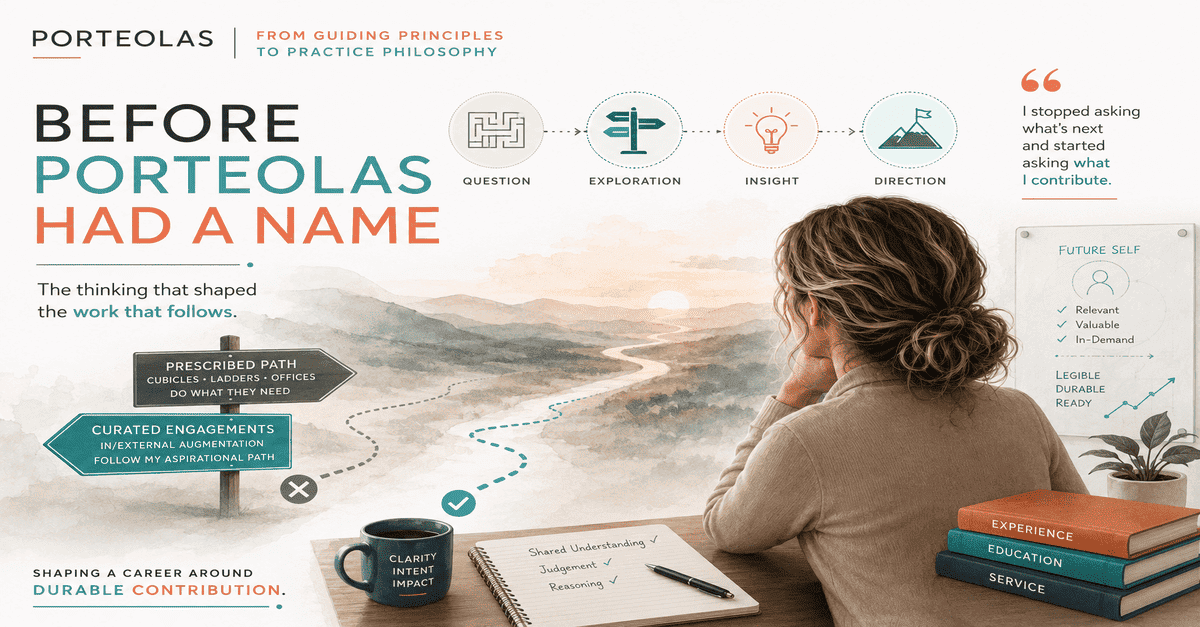
The Question: What decision was I trying to make?
How do I further my agility in navigating a dynamically volatile workforce – where people are increasingly:
- Commoditized
- At risk of being obsolesced by AI
- Designed out of traditional career paths as they age – dismissing 20+ years of accumulated experience and value-add?
The Temptation: What would’ve been the obvious / easy answer?
Disregard my ‘great recession’ experience:
- Resignation of NY role preceded graduating from MS ORSA program (May’10) to return to the southeast
- 18hr days submitting applications from May’10 – Nov’10 (7mo)
- Nov’10 position continued to get delayed (budget stop-gaps) through spring 2011
- In the interim, I’d landed another opportunity (Apr’11) – eleven months after graduating
- By the time the ‘Great Recession’ hit:
- I was in my late 20’s
- I’d already served my country 6yrs
- Worked FT putting myself through my BS Physics
- Worked FT (rotating shifts) putting myself through my MS ORSA
- You see, I wasn’t ‘simply’ a “new graduate” – I had a wealth of professional & education acumen to bring to my new team; even still – it took eleven months to attain employment, at a rate that was half of what I was “worth”
- I’ve already seen these antics, and survived them – it’s a ‘one-and-done’ for me; to the opportunity to ‘repeat’ – I say: no thank you…
Maintain the deceptive “fiscally safe” status quo facades:
- With a company nearing its 100th year?
- In a recession proof industry?
- On a newly implemented team / department / initiative?
Continue:
- Shrinking myself to ever lower perceptions of viability (ageism)
- Trading my future for my present; ignoring how deferring erodes my ability to establish the positioning my future self will rely on
The Consequence(s): of deferring my career positioning?
I would have less time / space to resolve:
- My transition from ‘generalist’ to ‘specialist’
- What AI will not be able to replicate (in the near future) that maintains / increases my viability for remaining ‘in-demand’ for the next 20+ years
- Where and how to establish my relationships and reputation within the ecosystems I discover to be ones I desire
The Exploration: What changed as I learned more?
How the ‘soft-skills’ developed through cross-domain integrative reasoning – particularly for tradespace and traceability are my true differentiators:
- Establishing shared understanding and single sources of truth
- Exploring alternative technologies, processes, and procedures
I’d been developing these capabilities throughout my career. They underpinned the success of my technical contributions. And that – that – would be what differentiates me in the “AI-era”.
The Insight: What principles emerged?
Positioning shift – from ‘generalist’ to ‘specialist’. My ORSA training established broad acumen across quantitative methods, project management, information systems, e-commerce, and business planning – just to name a few. Every professional role I’ve held has drawn extensively on these capabilities.
Transitioning:
- From the ‘prescribed path’ rooted in “NEED me to know” so I can ‘do’
- To ‘curated’ development and engagements aligned to the career I aspire toward
- Thereby, prioritizing fidelity to that direction over unvetted non-durable pursuits – shiny objects, trends, and/or hype
How, over my career, I’ve prioritized “form” over execution; thereby:
- Reducing future decision latency and/or cognitive load
- Establishing legible / durable operational readiness
The Porteolas connection: How does this influence how I work today?
Systems reasoning has been the consistent contribution across my career – and that’s why Porteolas is a systems reasoning company with:
- A philosophy of: Integrative Reasoning
- A purpose for: Establishing Shared Understanding
- An intention for outcomes to facilitate: legible / agile decisions
- Niched in tradespace and traceability
Now, I’m designing my future based on my durable contribution – curated by “Where can this way of reasoning create the most value?”


