
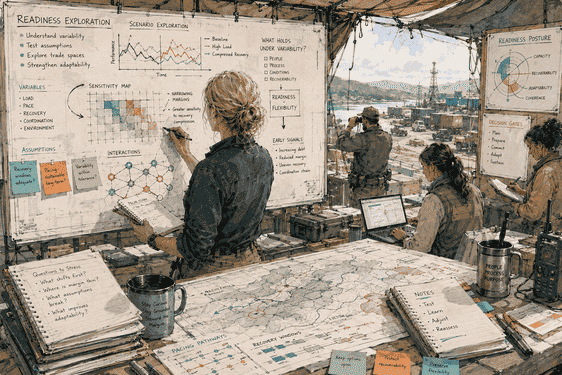
SCENARIO (What’s happening):
Operational environments rarely degrade all at once.
More often, conditions begin shifting incrementally: workload becomes uneven, recovery windows change, staffing depth fluctuates, coordination demands increase, and operating tempo becomes less predictable.
Performance may continue – but, the conditions supporting that performance may be changing underneath it.
That distinction became the focus of this applied research scenario: exploring how operational variability reshapes readiness before visible performance degradation appears.
Rather than treating readiness as a static condition, the scenario uses a Daniels-Banister-inspired fatigue / recovery simulation as an exploratory environment for examining how changing load, recovery, pacing, and adaptation assumptions can influence readiness trajectories over time.
The objective is not to predict a singular future state; it’s to make variability more visible – so assumptions about sustainable performance can be examined before they quietly become dependencies.
The simulation provides the modeled analytical surface. Staffing, coordination behavior, organizational interpretation, and other operational conditions introduced throughout the scenario remain exploratory scenario conditions used to reason about what modeled variability might mean in practice. They are not organizational behaviors demonstrated by the model itself.
Within that applied scenario,

Fox (Interested Stakeholder)
have reason to care when continued performance remains visible while the conditions supporting it become increasingly variable. Their stake may differ – accountability, operational dependence, readiness responsibility, or exposure to the consequences – but the underlying concern is shared:
When does an observable performance signal stop being sufficient for understanding the readiness conditions beneath it?
The underlying question is straightforward:
How well do current readiness signals reveal the conditions required to sustain performance as operating conditions change?
Throughout the scenario, Porteolas’s narrative archetypes serve as perspective scaffolds for interrogating the challenge. They do not represent actual stakeholders or participants. Each introduces a different reasoning perspective through which assumptions, signals, tensions, and adaptations can be examined
Together, W.E. S.E.A (How this is being approached):
W: What’s Next Previews

metaphor (patterns & tensions)
highlights how operational environments increasingly face conditions where workload variability, pacing instability, and shifting coordination demands evolve faster than traditional readiness assumptions.
The future challenge may therefore be less about insufficient performance visibility and more about insufficient understanding of sustainable readiness variability.
This distinction matters.
Traditional readiness indicators often emphasize current output, availability, or completion rates. These measures remain useful, but they may reveal less about how much variability the underlying system can absorb before recovery capacity, coordination flexibility, or adaptation margins begin narrowing.
The simulation environment provides a way to explore these conditions without assuming current performance automatically represents sustainable readiness.
By varying load, recovery, pacing, and adaptation assumptions, the environment can expose different modeled trajectories and sensitivities.
The contribution is not simply producing additional visibility – it’s connecting modeled variability with the operational context needed to interpret what those changing signals might mean.

Quantitative Methods
perspective helps examine whether apparently stable performance signals remain informative as underlying conditions change.

Disruption Steward
perspective asks what those changes could mean if operating assumptions continue evolving faster than the interpretations build around them.
The question becomes
less:
“Are we performing?”
more:
“What conditions are currently making that performance possible – and how stable are they?”
E: Enhancements
The simulation was developed as an exploratory environment rather than a deterministic forecasting mechanism.
Different load patterns, recovery schedules, coordination pacing assumptions, and threshold conditions can be varied to examine how readiness trajectories respond.
This makes it possible to explore:
- workload sensitivity,
- recovery variability,
- pacing instability,
- adaptation pressure,
- and conditions under which apparently stable performance may depend upon increasingly narrow margins.
Sleat’s perspective is useful here because variability itself becomes informative.
A system that performs predictably under stable conditions may reveal relatively little about how it behaves when assumptions change. Introducing controlled variability can expose interactions and dependencies that remain hidden during equilibrium.
The objective – therefore, is not simply: optimize a readiness metric; it’s to understand:
- which assumptions remain robust,
- which become sensitive to changing conditions,
- and where additional context may be necessary before interpreting an output as evidence of sustainable readiness.
S: Stewardship
Stewardship shifts attention from maintaining current performance toward preserving the conditions that make performance sustainable.

Risk Sentinel
perspective asks:
- Which assumptions about workload and recovery are becoming embedded?
- Which readiness signals remain trustworthy as operating tempo changes?
- Where might apparently sustainable performance depend upon informal compensation or shrinking recovery margins?
- What conditions would warrant revisiting the interpretation?
These questions become increasingly important when operational systems continue functioning while the conditions supporting that function change.
The risk is not necessarily immediate failure; it may – instead – be a gradual reduction in flexibility, recoverability, or interpretive confidence.
Stewardship, therefore, requires attention not only to what a system is producing, but also to whether the assumptions used to interpret that production remain defensible.
E: Engagement
Quantitative visibility alone cannot establish the meaning of readiness.

Qualitative Methods
perspective surfaces where operational realities resist reduction to a single metric: informal coordination practices, compensating behaviors, local adaptations, changing work rhythms, or contextual constrains that may influence how modeled variability should be interpreted.
These conditions are not outputs of the fatigue / recovery simulation. They represent contextual questions an applied scenario would need to investigate before translating modeled behavior into organizational meaning.

Adaptability & Improvement
perspective then asks whether those interpretations remain revisitable:
- Can assumptions be updated as conditions change?
- Can operational learning influence how readiness is interpreted?
- Can decision structures retain enough flexibility to incorporate evidence that doesn’t fit the original framing?
The interaction between modeled variability and contextual observation becomes especially important here.
Additional signals don’t automatically create additional understanding.
Interpretation improves when operational context remains connected to modeled variability.
A: Agility Tips
Agility, in this context, doesn’t mean reacting continuously to every change – rather: maintaining enough interpretive flexibility to distinguish ordinary variability from changing conditions that may alter the sustainability of current performance.
The simulation environment supports this by allowing assumptions to be varied rather than treated as fixed – that creates opportunities to examine:
- which conditions produce meaningful sensitivity,
- where recovery margins begin changing,
- which assumptions remain comparatively robust,
- and where additional operational context may be necessary before drawing conclusions.
The intent isn’t to automate the resulting judgment – it’s to preserve enough visibility into changing conditions that assumptions can remain open to challenge before performance drift becomes obvious.
Evidence Surfaces (What emerged through engagement with the challenge):
Rationale & Tradeoffs
Operational readiness decisions often rely on simplified indicators because organizations need usable information.
The tradeoff is that simplification can obscure the conditions beneath performance; therefore, the simulation environment explores readiness as a dynamic relationship among load, recovery, adaptation, and pacing rather than as a singular output condition.
The resulting tension isn’t between ‘measurement’ and ‘no measurement’ – it’s between
performance visibility and sustainable-readiness understanding.
This scenario asks whether readiness indicators reveal only what the system is currently producing – or also provide enough insight into the conditions making that performance sustainable.
This matters because optimization and efficiency gains can improve near-term performance while potentially reducing flexibility under future variability.
The objective isn’t to reject efficiency; it’s to preserve visibility into the tradeoffs accompanying it.
Exploratory Scenarios
The simulation environment supports several exploratory pathways.
These are not forecasts. They are reasoning environments for examining how changing assumptions and conditions might alter readiness interpretation.
Scenario 1 – Workload variability
Explore how uneven, or changing, workload patterns influence modeled fatigue, recovery, and readiness trajectories.
Scenario 2 – Recovery timing
Explore whether changes in recovery opportunities alter the apparent sustainability of continued performance.
Scenario 3 – Coordination pacing
Examine how different pacing assumptions may interact with modeled readiness conditions and whether apparently stable output depends upon increasingly narrow flexibility.
Scenario 4 – Efficiency and variability
Explore wither efficiency gains that improve near-term output may also reduce flexibility under future variability.
Scenario 5 – Adaptation and continuity
Explore whether pacing or recovery adjustments could preserve readiness while maintaining operational continuity – and under what assumptions that interpretation remains defensible.
The purpose of these scenarios isn’t to identify a universally optimal operating condition; it’s to:
- expose sensitivity,
- reveal dependencies,
- and make competing interpretations available for examination.
Retrospectives
Retrospective reasoning helps distinguish current visibility from accumulated understanding.
Looking backward across modeled trajectories can reveal where:
- recovery assumptions remained valid,
- workload conditions changed,
- apparent stability depended upon compensating conditions,
- or previously reasonable interpretations became less defensible as circumstances evolved.
Oir’s perspective is useful here because retrospection isn’t simply about determining whether a previous decision was right or wrong; it’s asking whether the reasoning supporting that interpretation remains traceable:
- what did we believe?
- under what conditions?
- which signals supported that belief?
- what subsequently changed?
This preserves the ability to learn from evolving conditions without pretending that later information was available earlier.
Thinking Aloud
This scenario leaves several questions intentionally unresolved:
Ally asks:
Sleat asks:
Oir asks:
Bailey asks:
Eona asks:
“What operational context is missing from the modeled signal?”
“How much variability can the system absorb before current readiness assumptions become unreliable?”
“Which conditions would warrant reconsidering the interpretation?”
“Can the system adapt without losing visibility into why the original assumptions changed?
“How do we steward these different signals, conditions, and perspectives without prematurely collapsing them into a signal interpretation?”
These perspectives don’t produce a single answer – together, they make different dimensions of the decision environment available for reasoning.
The model can expose behavior under changing assumptions.
Operational meaning still requires context, synthesis, and human judgment.
Toolchain / Stackmap
The decision environment brings together several forms of analytical and interpretive work:
- fatigue / recovery simulation modeling,
- variable load experimentation,
- exploring sensitivity to assumptions,
- adaptation/recovery interpretation,
- scenario variation / stress-testing,
- qualitative perspective-taking,
- operational-contextual considerations,
- and decision stewardship.
The purpose of the stack isn’t to make every possible analytical technique visible; it’s to connect modeled variability with enough contextual reasoning to examine what changing signals can – and cannot – responsibly support.
Meaning doesn’t emerge from the simulation alone; it develops through the interaction among the modeled conditions, operational context, assumptions, perspectives, and judgment.
Emerging Patterns & Watchlists
Several patterns become worth watching as operational conditions evolve:
- performance continuity accompanied by narrowing recovery margins,
- increasing dependence on assumptions established under more stable conditions,
- readiness indicators that emphasize output more clearly than recoverability,
- efficiency gains that reduce flexibility under changing demand,
- coordination practices that compensate for strain without making that strain immediately visible,
- and growing confidence in signals whose operational context has become less clear.
These patterns aren’t predictions of failure – they’re conditions that may warrant additional interpretation.
The objective is to preserve adaptability, recoverability, and operational understanding before changing conditions quietly narrow the system’s available options.
Operational Reflection (What’s shaping your choices):
The scenario ultimately returns the reasoning to the operating environment:
- Where are current workload assumptions based on stable conditions that may no longer exist?
- Are readiness indicators reflecting recoverability – or simply current output continuity?
- Where have coordination efficiencies reduced operational flexibility?
- Which pacing assumptions remain valid under increasing workload variability?
- What operational signals remain invisible because teams continue compensating successfully?
These questions remain deliberately unresolved.
The purpose of the decision environment isn’t to convert modeled variability into stakeholder decisions; it’s to make enough of the underlying conditions, assumptions, and interpretive tensions visible that those responsible for the decision can examine what:
- still holds,
- deserves challenge,
- may need to remain open as conditions continue evolving


