
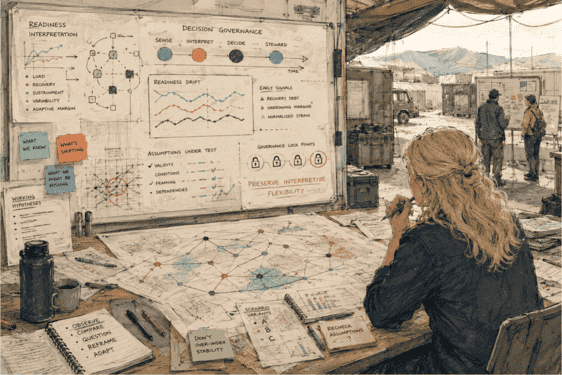
Interpreting Readiness Before Governance Locks
SCENARIO (What’s happening):
A Daniels-Banister-inspired fatigue / recovery simulation environment provides a way to explore how changing load, recovery, adaptation, and pacing assumptions influence modeled readiness conditions over time.
The model is deliberately exploratory. Its purpose is not to prescribe an optimal training or readiness strategy, nor to convert a physiological model into an organizational answer. Instead, the environment creates a surface for varying assumptions, observing modeled behavior, and asking what those changing conditions might mean when organizations begin using readiness signals to inform consequential decisions.
That distinction matters.
The simulation can expose modeled patterns such as accumulated fatigue, recovery sensitivity, adaptation, and changing performance trajectories. Questions about governance, reporting, institutional behavior, or decision thresholds belong to the applied scenario surrounding the model. They are conditions to reason about and challenge – not empirical findings produced by the simulation itself.

Fox (Interested Stakeholders)
have reason to care about what happens as those signals move beyond exploration and begin informing reporting, expectations, thresholds, or institutional commitments. Their stake may differ – accountability, operational dependence, governance responsibility, or exposure to the consequences – but the underlying concern is shared:
What becomes harder to question, revisit, or trace once an interpretation begins to institutionalize?
The scenario therefore asks:
How might organizations preserve decision legibility as evolving operational signals begin becoming institutionalized?
Note: Throughout the scenario, Porteolas’s narrative archetypes serve as perspective scaffolds for interrogating the problem. They do not represent actual stakeholders or participants in an engagement. Each introduces a different reasoning perspective through which assumptions, tensions, risks, and adaptations can be examined.
Together, W.E. S.E.A (How this is being approached):
W: What’s Next Previews
The Daniels-Banister-inspired readiness simulation environment was initially developed as a sandbox for exploring how changing conditions influence fatigue, recovery, and performance trajectories over time.
Within the environment, assumptions can be varied rather than treated as fixed. Changes in operational tempo, workload accumulation, recovery intervals, adaptation pressures, and related model conditions allow different trajectories to emerge.
Those modeled behaviors create the entry point for a broader Alignment & Governance scenario:
What happens when signals generated under changing conditions begin informing decision systems that prefer stable interpretations?

Disruption Steward
helps frame that tension:
The challenge is no longer simply observing modeled readiness. It becomes considering whether the decision structures surrounding those signals could remain aligned with changing conditions as interpretations become repeated, standardized, or eventually embedded within governance.

metaphor (patterns & tensions)
becomes visible through possibilities such as:
- threshold normalization,
- simplified readiness categories,
- reporting dependency,
- and pressure to translate evolving signals into increasingly stable decision mechanisms.
None of those organizational conditions are outputs of the physiological model. They are scenario assumptions introduced deliberately so they can be challenged.
That distinction preserves the exploratory nature of the environment: modeled behavior provides evidence to reason with; governance interpretation remains a matter of context and judgment.
E: Enhancements

Quantitative Methods
constructs the decision environment in which what becomes visible when the simulation is used for exploration rather than prediction alone gets examined.
The emphasis is not predictive certainty; instead, the sandbox allows examination of:
- readiness variability,
- delayed effects,
- adaptation and recovery dynamics,
- sensitivity to changing assumptions,
- pacing asymmetries,
- and sustainment pressures under varying modeled load conditions.
The analytical value comes partly from varying assumptions rather than optimizing toward a predetermined answer.
Different parameter combinations and load patterns can be explored to ask:
- Which results remain relatively stable?
- Which become sensitive to changing assumptions?
- When does apparent performance continuity coexist with accumulating fatigue or reduced recovery?
- Which interpretations depend heavily upon the conditions under which they were produced?
The model itself does not determine what an organization should conclude from those observations.
Instead, it provides an analytical surface upon which assumptions and consequences can become more visible before they are translated into decision thresholds, policy, or governance.
Stable outputs do not necessarily mean stable conditions.
The enhancement trajectory therefore moves toward interpretive visibility: preserving uncertainty, exposing sensitivity, and allowing changing assumptions to remain available for examination.
S: Stewardship

Risk Sentinel
shifts attention from whether the simulation functions to what could happen after its outputs begin informing decisions.
That introduces a different set of questions:
- Which assumptions could become operational dependencies?
- Which readiness thresholds are exploratory, and which could actually be defended?
- Under what conditions might continuity be interpreted as resilience?
- What happens if a context-sensitive signal becomes institutionalized as though its meaning were fixed?
These are not questions the model can answer independently.
They require judgment about the relationship among modeled evidence, operational context, organizational objectives, constraints, and the consequences attached to an interpretation.
The scenario therefore explores a governance tension:
Operational conditions can continue changing after the interpretation used to govern them has stabilized.
Cant appears here as the possibility of accountability creep, metric dependency, threshold hardening, and increasing confidence in familiar reporting structures.
The stewardship challenge is consequently not whether the simulation is useful; rather – whether decision systems can preserve enough interpretive flexibility to remain accountable to changing conditions before incomplete interpretations become difficult to revisit.
E: Engagement

Qualitative Methods
introduces another boundary:
A quantitative sandbox can expose modeled behavior; however, it cannot independently explain the human and organizational context surrounding that behavior.
In an applied setting, additional perspectives might reveal conditions such as:
- compensating behaviors,
- local workarounds,
- changing adaptation strategies,
- reporting pressures,
- competing objectives,
- and/or incentives affecting how a readiness signal is interpreted.
These are possibilities the scenario asks us to investigate, not behaviors demonstrated by the Daniels-Banister-inspired model; therefore, Ally asks us to consider – not merely what a signal says, but what contextual information would be necessary before assigning meaning to it.

Adaptability & Improvement
extends the inquiry toward learning and revision:
- How readily can assumption be revisited?
- What evidence would cause an interpretation to change?
- Can governance structures accommodate changing validity conditions?
- Can uncertainty remain visible long enough to influence subsequent reasoning?
This is where quantitative evidence, qualitative context, and human judgment begin interacting.
The question is no longer: “How do we optimize readiness?”
It becomes: “How do we preserve coherent decision reasoning while the conditions informing readiness continue to change?”
A: Agility Tips
The modeled environment makes it possible to observe trajectories rather than only endpoints.
That matters because strain, adaptation, fatigue, and recovery need not produce immediate or obvious discontinuities. Different assumptions can be produce different trajectories while surface-level performance may remain interpretable in more than one way.
The governance scenario extends that observation carefully.
If changing conditions can remain partially obscured by familiar outputs, adaptability depends not merely upon reacting faster – it also depends upon retaining the ability to:
- revisit assumptions,
- challenge interpretations,
- examine sensitivity,
- preserve relevant uncertainty,
- and reconsider thresholds when their original conditions no longer hold.
Eona’s perspective returns here:
Decision systems need some means of remaining responsive to the conditions they are intended to represent.
That does not require perpetual indecision.
It requires recognizing the difference between establishing enough stability to act and treating that stability as evidence that the underlying conditions have stopped changing.
Evidence Surfaces (What emerged through engagement with the challenge):
Rationale & Tradeoffs
The simulation environment was not built to eliminate uncertainty.
It provides a controlled space for exploring how changing assumptions influence modeled fatigue, recovery, adaptation, and performance trajectories.
The Alignment & Governance scenario then introduces a separate question:
What happens when interpretations developed from evolving signals begin becoming stable decision mechanisms?
The resulting tradeoff is not between ‘data’ and ‘no data’.
It’s between the practical need for sufficient stability to support decisions and the need to preserve enough visibility into changing conditions, assumptions, and uncertainty to challenge those decisions when warranted.
The sandbox explores tensions between:
- continuity and sustainability,
- operational visibility and interpretive oversimplification,
- readiness categorization and evolving conditions,
- and governance consistency versus operational variability.
What matters is not merely the readiness conclusion reached – it’s whether someone can still understand:
why that interpretation remained reasonable under the assumptions and conditions present when it was made – and what would warrant revisiting it.
Exploratory Scenarios
The Daniels-Banister-inspired sandbox supports exploration of different modeled conditions, including:
- changes in load,
- pacing,
- recovery,
- adaptation,
- and other parameter assumptions.
Those variations allow us to examine questions such as:
- How do trajectories change when recovery opportunities change?
- What becomes visible under sustained versus variable loading?
- How sensitive are apparent readiness conditions to the assumptions used?
- Can similar surface observations emerge from materially different underlying conditions?
The Alignment & Governance scenario then uses those observations to explore possible downstream tensions and what if(s):
- an interpretation developed under one set of conditions becomes a standardized threshold?
- changing conditions no longer resemble those under which the threshold was established?
- stable reporting creates greater confidence while the assumptions supporting that interpretation become less visible?
These scenarios remain intentionally exploratory rather than prescriptive. Their purpose is to:
- surface tensions,
- expose dependencies,
- and improve preparedness for reasoning before an interpretation becomes difficult to challenge.
Retrospectives
Retrospective reasoning asks a different question:
What would we want to remain traceable if conditions later changed?
That might include:
- the assumptions used,
- the conditions under which an interpretation was formed,
- the alternatives considered,
- the uncertainties that remained unresolved,
- the contextual evidence available at the time,
- and the signals that subsequently challenged the original interpretation.
Oir’s perspective is particularly useful here:
Rather than assuming that later degredation proves an earlier decision was wrong, retrospective analysis can examine whether the original interpretation remained defensible given what was known at that time – and whether changing conditions were recognized soon enough to warrant reconsideration.
The objective is not hindsight certainty – it’s maintaining enough traceability to distinguish reasonable adaptation from unnoticed assumption drift.
Thinking Aloud
This scenario leaves several questions intentionally unresolved.
Ally asks:
Sleat asks:
Oir asks:
Eona asks:
“What contextual evidence would we need before treating a modeled readiness signal as operationally meaningful?”
“At what point does sustained output stop representing sustainable readiness?”
“What would have to remain traceable for us to challenge that interpretation later?
“When does useful decision stability begin becoming interpretive rigidity?”
Their questions expose
- the reasoning between artifact and decision
- how simulations can generate modeled behavior, but cannot infer interpretation
Institutional confidence requires synthesis across evidence, assumptions, context, competing objectives / incentives, consequences, and perspectives.
Toolchain / Stackmap
The simulation is one component within the reasoning environment.
Visible analytical elements include:
- fatigue / recovery simulation modeling,
- variable load experimentation,
- sensitivity to assumptions,
- adaptation/recovery interpretation,
- scenario variation / stress-testing,
- uncertainty framing,
- contextual inquiry,
- governance reflection,
- and qualitative perspective-taking.
No single element establishes meaning by itself.
The contribution emerges through their interaction: using an analytical artifact to make assumptions and consequences available for examination while retaining the human judgment necessary to determine what those observations mean within a particular decision context.
The objective here is not to expose a proprietary execution sequence; rather – it’s to make enough of the reasoning surface visible that someone else can question the assumptions, challenge the interpretation, or recognize where similar tensions exist in their own environment.
Technologies / environments developed & deployed within the prototype include:
- Python
- GitHub
- Snowflake
Emerging Patterns & Watchlists
The Alignment & Governance scenario suggests several conditions worth watching when evolving signals begin informing increasingly stable decision structures:
- growing dependence on simplified readiness thresholds,
- increasing institutional confidence in familiar outputs,
- declining visibility into the assumptions behind the interpretation,
- reduced tolerance for ambiguity,
- thresholds persisting after their original conditions change,
- and narrowing opportunities to reconsider an interpretation once it becomes embedded within governance.
These are not predictions produced by the simulation – they’re governance hypotheses and watch conditions surfaced by reasoning across the modeled environment and the applied scenario.
Cant is most useful here – as a reminder of how consequential changes can accumulate incrementally.
Systems don’t necessarily lose legibility through one obvious failure. Sometimes the more consequential change is quieter:
interpretive flexibility narrowing while confidence in the established interpretation continues to grow.
Operational Reflection (What’s shaping your choices):
At what point does operational continuity begin masking narrowing adaptive margins?
Which assumptions within current governance processes were formed under conditions that may no longer exist?
How much confidence rests on current operational visibility – and how much rests on familiarity with stable reporting structures?
Where have decision thresholds become easier to defend administratively than to validate operationally?
What signals currently remain visible only because governance has not yet fully stabilized around them?


