
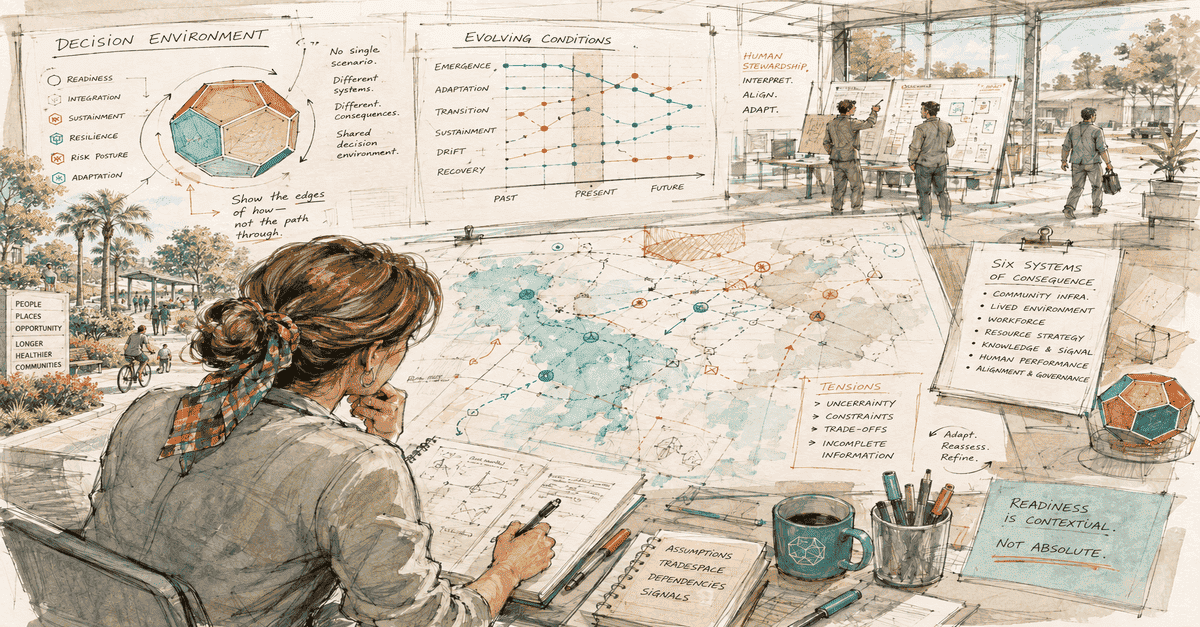
One Decision Environment. Six Systems of Consequence.
What happens when the same analytical environment is viewed through different dimensions of a consequential decision?
That question sits behind this 6-part Applied Research Topic series.
I built a Daniels-Banister-inspired fatigue / recovery simulation to explore how changing assumptions about load, adaptation, fatigue, and recovery can influence modeled trajectories over time.
The simulation provides an analytical surface.
It does not:
❌ provide the decision,
❌ determine whether someone is ready,
❌ prescribe an appropriate level of strain, or
❌ establish what an organization should do.
Instead, it makes selected dynamics and their underlying assumptions available for exploration.
And that creates an interesting systems question:
What else becomes consequential once those dynamics must be interpreted within an operating environment?
That is where these six scenarios begin.
A common decision environment:
The scenarios share the same fictional-but-plausible Daniels-Banister-inspired simulation decision environment.
Imagine an organization reasoning about human adaptation, recovery, and readiness under changing conditions.
Observable performance continues.
Operational demands evolve.
Recovery and adaptation matter.
And a bounded simulation provides one way of exploring how selected fatigue / recovery dynamics behave under different modeled assumptions.
But the model exists inside a larger system.
What becomes visible through the model still must be interpreted.
Interpretation may influence how workforce capability is understood.
Sustained participation may depend upon physical and lived conditions outside of the model.
Finite resources may shape which conditions can be supported or preserved.
And interpretations may eventually become embedded in expectations, structures, or governance.
The decision environment simulation does not model those consequences.
These six decision system scenarios provide different perspectives from which to reason about them.
Six different questions:
Each scenario begins with the same underlying analytical decision environment but asks something different of it.
ALIGNMENT & GOVERNANCE (AG):
What happens as interpretation begins hardening into governance?
Eventually, provisional interpretations may influence thresholds, expectations, policies, structures, or other commitments.
At that point, another question becomes consequential:
Which assumptions deserve to harden – and which need to remain revisitable?
The model doesn’t answer that question – it helps make some of the assumptions and dependencies informing it more visible before commitments narrow the available tradespace.
KNOWLEDGE & SIGNAL (KS):
Do the signals we’re observing mean what we think they mean?
More visibility doesn’t necessarily produce more understanding.
Performance can remain observable while the conditions supporting it change.
Modeled variability provides something to examine, but operational meaning still depends upon assumptions, context, synthesis, and human judgment.
The challenge becomes not merely collecting signals – but maintaining confidence that their interpretation still fits.
RESOURCE STRATEGY (RS):
How are finite resources positioned while the conditions they support remain adaptive?
Resources bring constraints, expectations, and tradeoffs.
Funding structures may emphasize outcomes, utilization, reporting, standardization, or expansion – none of those conditions are modeled by the fatigue / recovery simulation.
Instead, the scenario asks how resource assumptions interact with adaptive realities – and what may become harder to preserve as commitments mature.
INFRASTUCTURE & LIVED (IL):
Do environments merely make opportunities available – or do lived conditions permit people to sustain participation in them?
Adaptation requires opportunity for repeated engagement.
That creates questions extending beyond physiology into the environments in which participation occurs.
The simulation doesn’t model parks, accessibility, transportation, or community wellness.
It provides the adaptation / recovery lens from which a broader system becomes available:
What conditions support – or interrupt – the sustained participation through which adaptation can accumulate?
WORKFORCE READINESS (WR):
How sustainably is capability being carried as readiness conditions evolve?
A workforce can remain staffed, qualified, and operational while the conditions through which capability is sustained become more variable.
The simulation doesn’t model staffing, proficiency, scheduling, or organizational capability.
Instead, modeled human-readiness dynamics provide one analytical surface for questioning whether familiar workforce indicators tell the whole readiness story.
HUMAN PERFORMANCE (HP):
When does continued performance stop being sufficient evidence of sustainable readiness?
Here, the relationship to the simulation is most direct.
Changing assumptions about load, fatigue, recovery, and adaptation produce modeled trajectories that can be examined over time.
But those trajectories remain conditional.
Operational context and human judgment are still required to determined what they mean.
These six decision systems aren’t six steps in a process.
Nor are they six applications supposedly contained within the simulation.
They’re different systems of consequence surrounding the same decision environment – where consequence implies a stake.
Throughout these scenarios, someone is accountable to, impacted by, dependent upon, or otherwise invested in how the conditions being explored unfold or are being addressed – they are ‘invested stakeholders’, representing for whom Cant’s metaphors of systems become consequential.
A ‘Human Performance’ question can become a ‘Knowledge & Signal’ problem when the meaning of a readiness indicator becomes uncertain.
That interpretation can become a ‘Workforce Readiness’ concern when organizational capability depends upon it.
‘Infrastructure & Lived’ conditions can affect whether opportunities for sustained participation remain usable.
‘Resource Strategy’ choices can influence which conditions are supported, constrained, or preserved.
And interpretations arising anywhere within that environment can become ‘Alignment & Governance’ concerns once they begin informing commitments.
In short, these systems intersect – but they don’t become interchangeable.
Showing the edges of how:
The objective of this Applied Research Topic isn’t to produce six answers – it’s to make a consequential decision environment more legible.
Across the six scenarios, I use modeling, assumptions, fictional-but-plausible operating conditions, quantitative and qualitative perspectives, risk questions, and operational reflection to examine what becomes visible when the same situation is viewed from different systems of consequence.
Some relationships are modeled.
Others are contextual.
Some are hypothetical.
Others remain unresolved questions requiring additional evidence, stakeholder knowledge, or decision authority.
Preserving those boundaries is part of the reasoning.
Because the value of an analytical environment doesn’t come from making every uncertainty disappear – sometimes, its value is making assumptions, dependencies, tensions, alternatives, and limits visible enough that people can recognize what deserves to be questioned before deciding.
That is the purpose of this series:
One decision environment, explored through six systems – showing the edges of how without prescribing the path through.


