
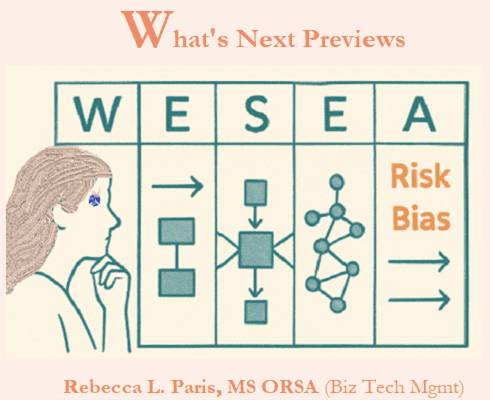
From ambiguity to action: Lessons forged across physical extremes, system constraints, and cognitive overload
Whether you’re facing physical extremes or cognitive overload – presence and consistency are what carry you forward. That’s agility for what’s next.
Humans are more important than hardware:
This insight isn’t just theory. It’s field-tested. I’ve lived it across divergent terrain: from standing up compliance functions in legacy organizations to deploying real-time dashboards under pressure, to de-biasing high-stakes proposals before success was compromised.
This post marks the foundation of my content strategy and my professional niche: helping organizations build risk-informed, bias-aware decision systems for strategic planning and performance futures. Let’s unpack how this emerged from experience – and why it matters.
Not Just Concepts – Real Decision Disruptors
Risk and bias are often seen as abstract or academic. But they are real forces that shape – and sometimes distort – decisions every day. Here’s how I encountered them in practice:
- Undeterred by Expertise Barriers: I faced confirmation and anchoring bias head-on while delivering viable tech solutions – despite not holding a computer science degree. My strategy? Lead with stakeholder framing, scenario modeling, and systems insight. The solution wasn’t about code first; it was about clarity of purpose.
- Detecting Overconfidence Before Execution: In grant proposal evaluations, I surfaced embedded overconfidence and confirmation bias before the project launched. These early interventions helped prevent flawed benchmarks from undermining execution and continuity planning.
- Standing Up Risk Infrastructure From Scratch: In a 90+ year-old organization adapting to sweeping regulatory change, we built a risk and compliance function from the ground up. This required translating regulatory ambiguity into operational clarity – while integrating new processes with legacy culture.
- Real-Time Decision-Support Dashboards: While designing and deploying planning tools, I actively countered cognitive biases like the planning fallacy, action bias, and availability bias. These weren’t theoretical obstacles – they surfaced in how teams interpreted timelines, acted prematurely, or over-relied on recent data.
Each scenario demanded more than technical execution. It required:
- Tactical clarity: What needs to happen and why?
- Human performance mindset: How are teams positioned to act effectively under stress?
- Design fluency: Can we build systems people will actually use?
- Technical fortitude: Are we prepared to build what doesn’t yet exist?
Why Agility Is Strategic, Not Just Operational
“Agility” gets tossed around as a buzzword. But in my work, agility is grounded. It’s a capacity for presence and consistency in the face of uncertainty, overload, and ambiguity.
Agility means:
- Staying present when overwhelmed by data, choices, or volatility
- Being consistent when systems break down or stakeholders diverge
- Building infrastructure that aligns short-term execution with long-term judgment
And this is where decision sciences meet human systems – where operations research, scenario analysis, and bias mitigation converge into usable, visible strategy.
My Niche: Decision Systems for Strategic Planning and Performance Futures
I help teams architect and deploy decision systems that:
- Are informed by risk, not driven by it
- Are aware of bias, not ruled by it
- Translate theory into execution-ready insights
Whether through dashboards, scenario models, or new compliance functions – my approach is built for environments where decisions must align with outcomes, not just outputs.
What You Can Expect From My Content
The niche I’m infusing into the core of my approach:
- Real-world breakdowns of how bias and risk manifest in planning and execution
- Frameworks for human-aligned decision design
- Case studies and tactical insights from complex environments
- Experiments, visual tools, and strategic prototypes
If you’re navigating complexity and want to make your insights more actionable – and your decisions more agile – let’s stay connected.
James 1:5 (NIV): “If any of you lacks wisdom, you should ask God, who gives generously to all without finding fault, and it will be given to you.”
Call to Action / Engagement
Are you ready to explore how your business can integrate outdoor wellness into its strategy for growth? Start by identifying local green spaces or collaborate with planners on future projects. Nature is calling, and it’s time to respond!
- Subscribe to my blog
- Sign up on my newsletter, using ‘Connect’ form
- Connect on social media, I’m on:
- YouTube (soon)
